On many mines a blast lives in four or five places. The design sits in a design package. The hole-by-hole record is in a blast system or a spreadsheet. The magazine book is on paper or in a separate register. Bit life and hour meters are in the rig maker's portal, and production, stoppages and geology are somewhere else again. A straight answer to "what did that blast cost, and how did it dig?" means pulling all of them together by hand.
Eclipse Drill & Blast keeps them in one place.
What it covers
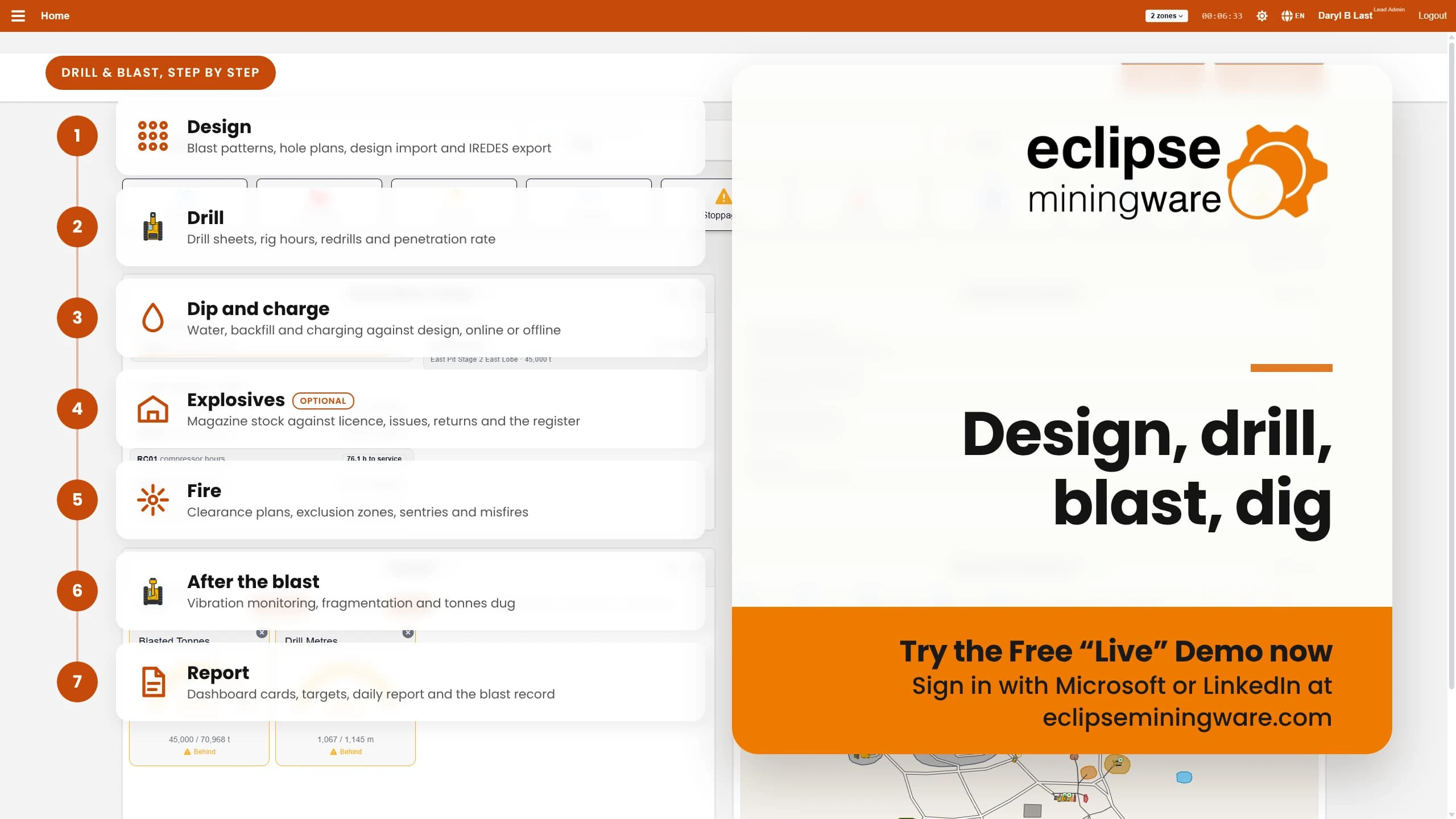
Every hole. Import the design, then record drilling, redrills, dips, water, backfill and charging against each hole, on a tablet at the bench (with or without signal) or on sheets printed from Eclipse. The plan shows every hole's status at a glance. Crews who would rather record drilling as summary lines per pattern can do that instead.
Explosives. A magazine register kept by shift, covering receipts, issues to a blast, returns, transfers, destruction and stocktakes. Each magazine's stock is shown against its licence limit, expiring lots are flagged, and every blast is reconciled product by product before an admin signs it off.
Firing and after. Firing records with the shotfirer and sentries, a printable clearance plan, misfires tracked through to clearance, and vibration and airblast readings judged against your limits. Fragmentation and the dig-out of each blast follow on. An open misfire is shown on the digging screen for that ground, so the excavator crew knows before they start.
Rigs and consumables. Engine, percussion and compressor hours with service due, every bit and rod fitted to and taken off each rig, bit life, regrinds, oil and grease issues, and the cost per metre that comes from them.
The paperwork. Drill, dip and loading sheets, magazine issue slips, the clearance plan and a complete blast record as a PDF.
Set up for each mine
No two mines run drill and blast the same way, so Eclipse ships with more than most sites will use and lets each one switch off what it doesn't need. Hole-by-hole recording, the explosives store, drill consumables, hour meters, monitoring, grade control and bulk precursors are separate modules. Settings cover units (metric or US), tolerances, register shift length, stock valuation and currency. Regulatory profiles for Western Australia, Queensland, US MSHA and Thailand's DPIM set the compliance rules, with a general profile for everywhere else. Drilling and blasting contractors can work in the same system and see only their own rigs and areas.
Works with the software you already use
You keep your design package. Patterns come into Eclipse as a CSV hole table, and Eclipse remembers each export's column layout, so later imports need no setting up. Drill plans go out to the rigs, and the rigs' drilling reports come back, in IREDES, the open exchange standard the major rig makers support. For sites that run BlastLogic, a connector that keeps BlastLogic as the system of record and brings its data into Eclipse is next on our roadmap.
Drill & Blast can run as a standalone module with just the shifts, pits and plant list it needs. Add the rest of Eclipse (production, haulage, stoppages, geology and plant) and the blast becomes part of the mine's record instead of an island.
One place to report from
Because the blast sits in the same database as the rest of the mine, it reports with it. Drill and blast figures appear in the daily report and the morning meeting pack, on dashboard cards and against targets, like any other KPI. The Report Builder takes a request in plain English, such as drill metres by rig this month against budget, and builds the report from live data. The same figures are open to other systems through a structured reporting API with API keys, so Power BI, Excel or your own tools can read them directly.
How it compares
We found no other product that covers all of this. This is how Eclipse compares with the rest of the market, based on each vendor’s published material in October 2026.
Where Eclipse matches the specialists
- Hole-by-hole drilling, dipping and charging, as the drill and blast suites and the explosives makers’ platforms do.
- Vibration and airblast results against your limits, as the explosives makers’ platforms do and some suites do in part.
- An explosives magazine register, as the dedicated registers and some drill and blast suites do.
- Tablets that work offline, as most of the market does.
Where Eclipse goes further
- Misfires followed through to clearance and shown to the dig crew. Elsewhere, misfires are recorded against the hole but not tracked beyond that.
- Drill bits, rods, bit life and percussion hours for every make of rig. The drill makers track these only for their own tools and rigs, and we found them in no drill and blast suite or explosives maker’s platform.
- The blast in the same system as production, stoppages and geology. No other product we surveyed keeps charging, firing and explosives alongside the rest of the mine’s record.
Where Eclipse works with what you have
- Pattern design. Eclipse imports designs from your design package rather than replacing it.
Products compared: Maptek BlastLogic, Datamine DataBlast Pro, Hexagon MinePlan Blast, Orica BlastIQ and SHOTPlus, Dyno Nobel Nobel Fire, LiveMine EXM, Magman, and Epiroc’s and Sandvik’s drill software.